Protium Green Solutions has been successful in getting two projects shortlisted in the second Hydrogen Allocation Round. What does this mean for the green hydrogen market in the UK and how can this help you?
What is the Hydrogen Allocation Round?
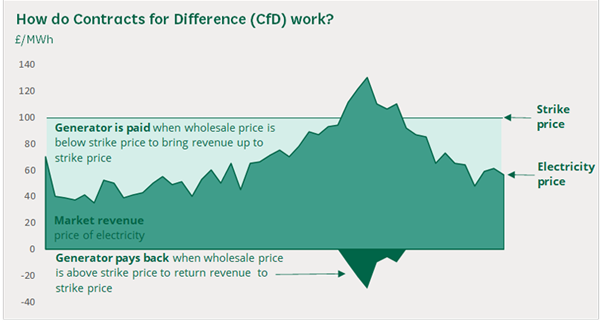
The Hydrogen Allocation Round (HAR) is the UK Government’s competitive tender for low carbon hydrogen projects to support the transition from fossil fuels to green hydrogen. Projects that are selected receive a Contract for Difference-style subsidy, which allows the end user to switch from their incumbent fossil fuel source to low carbon hydrogen at a commercially viable cost, linked to the price of natural gas. This price support helps overcome the currently high capital and operating costs of low carbon hydrogen, while the sector is still in its infancy. The contract is Government-backed and guaranteed for 15 years, with the expectation that after that period the production cost of low carbon hydrogen will have reached parity with fossil fuel.
Successful projects are awarded and sign a Low Carbon Hydrogen Agreement (LCHA).
HAR1
The Government’s first HAR opened in late 2022 and, in the Autumn Budget 2024, the Department for Energy Security and Net Zero (DESNZ) confirmed support for eleven green hydrogen projects (out of 20 shortlisted). These projects comprised £90 million in capital grant support through the Net Zero Hydrogen Fund and over £2 billion of revenue support through the Hydrogen Production Business Model (HPBM).
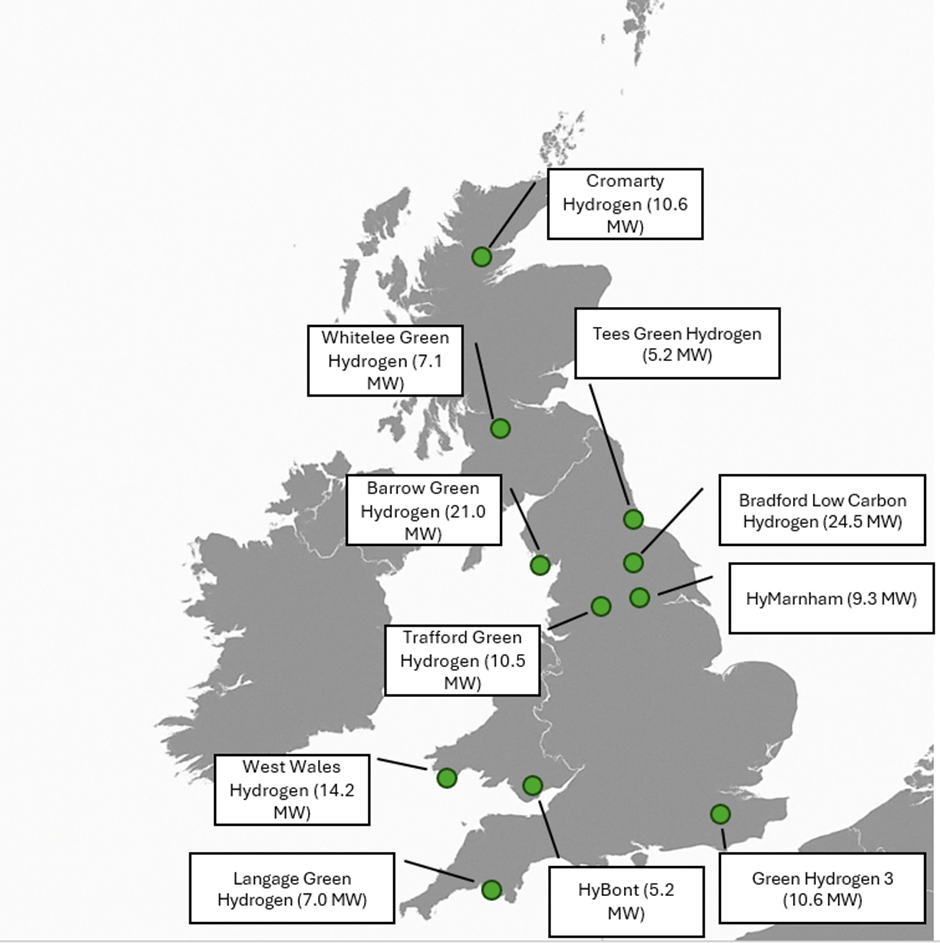
The eleven shortlisted projects combine for a total of 125 MW of capacity (equal to about 50 tonnes per day of hydrogen production). As of May 2025, six out of the eleven projects have officially signed the contract with all projects due to come online in 2026/27.
HAR2
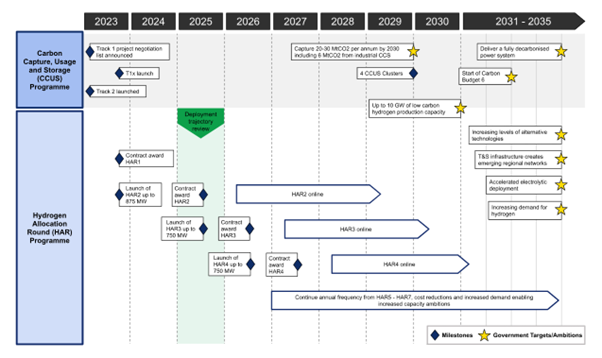
The second round opened from December 2023 to April 2024. A total of 27 projects were shortlisted (out of 87 applicants) on the 7th of April, for approximately 765 MW of low carbon hydrogen production capacity. This included 16 projects in England, 8 in Scotland and 3 in Wales. The operational date for these projects is between 2026 – 2029.
| Project name | Lead developer | Location |
| Hartlebury Green Hydrogen | Carlton Power Ltd | West Midlands |
| Walsall Green Hydrogen | Carlton Power Ltd | West Midlands |
| Singleton Birch Kilns | Centrica Energy Storage Ltd | East Midlands |
| Fawley Green Hydrogen | Hynamics Limited UK | South East |
| Tees Green Hydrogen Phase 2 | EDF Renewables Hydrogen Ltd | North East |
| Selms Muir Hydrogen | European Energy UK Ltd | Scotland |
| St Austell Green Hydrogen | Four Zeros Energy | South West |
| Binn Ecopark Hydrogen Facility | Binn Ecopark Hydrogen Ltd | Scotland |
| Creca Hydrogen Facility | Green Cat Hydrogen | Scotland |
| Strathallan Hydrogen Facility | Strathallan Hydrogen Ltd | Scotland |
| Grenian Hydrogen St Helens | Grenian Hydrogen Ltd | North West |
| Bardon Hill Hydrogen | Hygen Energy Holdings Ltd | East Midlands |
| Harper Lane Hydrogen | Hygen Energy Holdings Ltd | Greater London |
| Lhyfe Kemsley | Lhyfe SA | South East |
| Lhyfe Wallsend | Lhyfe SA | North East |
| Teesside Green Hydrogen | H2 Energy Ecosystem UK | North East |
| Green Hydrogen 5 | Green Hydrogen 5 Ltd | Wales |
| Magor Net Zero | Protium Green Solutions Ltd | Wales |
| South Tees Net Zero | Protium Green Solutions Ltd | North East |
| Grangemouth Green Hydrogen | RWE Generation UK Plc | Scotland |
| Pembroke Green Hydrogen 1 | RWE Generation UK Plc | Wales |
| Tyseley 10MW | Motive Fuels Ltd | West Midlands |
| Irvine Green Hydrogen Project | ScottishPower | Scotland |
| Whitelee Green Hydrogen Phase 2 | ScottishPower | Scotland |
| Aldbrough Hydrogen Pathfinder | Aldbrough Pathfinder Ltd | North East |
| Shetland Hydrogen Project 1 | Statkraft Hydrogen UK Holding | Scotland |
| Humber H2ub® | Uniper Hydrogen UK | East Midlands |
Further details on the potential total contract value will likely be released following confirmation of the final projects receiving funding after a due diligence stage.
Future Allocation Rounds
Following the recent release of the UK Industrial Strategy, HAR3 and HAR4 were confirmed for launch in 2026 and 2028 respectively, with up to 1.5 GW of green hydrogen projects expected to be awarded. Combined with HAR1 and HAR2, this will mean up to 2.5 GW of green hydrogen projects will receive funding by 2030.
What is required for an application?
To achieve a successful HAR application, there are several key factors DESNZ is looking de-risk to ensure deliverability of the project and value for the taxpayer. The considerations for any HAR application are:
- Minimising Cost – Capital projects ultimately come down to the cost and value for money is a key driver for all HAR projects. HAR1 achieved a weighted average strike price of £241/MWh (around £9.50/kg) with the expectation that subsequent HAR rounds will achieve a lower strike price. Cost reduction in the hydrogen industry remains a challenge with hydrogen technology costs not yet falling in line with expected learning curves. At Protium, we are build project cost estimates based not on assumptions, but on actual costs from our own built and in-development projects. Our in-house experts optimise the technical and commercial project design to help projects meet the value for money challenge faced by all HAR projects.
- Securing Offtake – Whether you are looking for a hydrogen supply or are aiming to develop a project, securing credible offtake contracts is a requirement for any hydrogen project. Protium has helped clients to make their operations hydrogen-ready and has aggregated offtake demand across the UK to support larger hydrogen hub projects.
- Securing Power – Power is a key input into the electrolysis process. Grid connections for large power users in certain regions of the UK can take more than 10 years to achieve energisation. As electrification of the UK gathers momentum, competition for grid connections grows. While the National Energy System Operator (NESO) is progressing reforms to support this, accessing a grid connection remains slow and complex. Protium can help navigate the challenging grid connection landscape to ensure hydrogen projects secure and reduce their grid connection timelines.
- Land and Planning – Competition is growing for suitable land for hydrogen projects, with significant competition from data centre and housing developers. Once land is secured, developers have to navigate the complex planning process and potentially manage several health and safety requirements including Control of Major Accident Hazards (COMAH) and Dangerous Substances and Explosive Atmospheres Regulations 2002 (DSEAR). Protium is one of the few companies to have achieved planning consent on both greenfield and brownfield land for hydrogen projects of various sizes.
- Water – Water scarcity in certain regions of the UK is becoming more prevalent and as the main feedstock in electrolysis, certainty of supply is required. Electrolysis requires a certain water purity which can be hard to achieve without potable supply. At Protium, we’ve successfully developed projects using either mains supply or repurposing wastewater from alternative local sources.
Protium Green Solutions has experience in delivering and being shortlisted for HAR applications. Get in touch with the team to find out how we can support your HAR-supported transition to hydrogen.