
The diesel generator has powered UK productions for decades. The industry has now committed to moving beyond it. Here is what the cleaner alternatives look like, where each one fits, and how green hydrogen helps productions make the shift without risking the shoot.
Every production needs power in places the grid does not reach: a castle courtyard, a moorland lay-by, an outside broadcast compound in a car park. For most of the industry’s history, the answer has been a diesel generator parked just out of shot.
That answer is changing. Broadcasters, studios and crews are asking for power that is cleaner, quieter, and easier to account for. The question for most productions is no longer whether to move away from diesel, but how to do it without putting the schedule at risk.
Why on-set power is under the spotlight
Temporary power is one of the most visible sources of emissions on a production, and the industry has said so publicly. BAFTA albert’s SPARK roadmap reports that UK productions burned more than three million litres of fossil fuel in generators in 2024, and that over half of all productions relied almost entirely on fossil fuels for power. (BAFTA albert, SPARK)
SPARK sets out the industry’s route to clean temporary power by 2030. It is backed by a Statement of Intent signed by BAFTA albert, the BBC, BFI, Channel 4, ITV, Netflix, Sky and others, and supported by a growing list of studios, film offices and suppliers. Its plan rests on three pillars: reduce energy demand, retool with cleaner technology, and reskill crews to plan and run it.
The pressure is not only environmental. Crews feel it in three practical ways:
- Sound: generator hum bleeding into takes means lost setups and reshoots.
- Location limits: noise and air-quality conditions can restrict night shoots and sensitive locations.
- Reporting: BBC TV commissions and recommissions have been required to achieve albert certification since January 2022, so every litre of diesel ends up in the production’s carbon footprint. (BBC, via Climate Action)
The footprint is significant. Data from around 80 BBC productions measured with the albert calculator puts UK TV production at roughly 8.2 tonnes of CO2 per hour of content. (BAFTA albert/BBC, via Carbon Visuals)
None of this means productions must have everything solved at once. As crew members told BAFTA’s own sustainability events, power is one of the areas where departments can make the biggest difference, and the range of cleaner kit available to hire keeps growing. (BAFTA)
The view from set
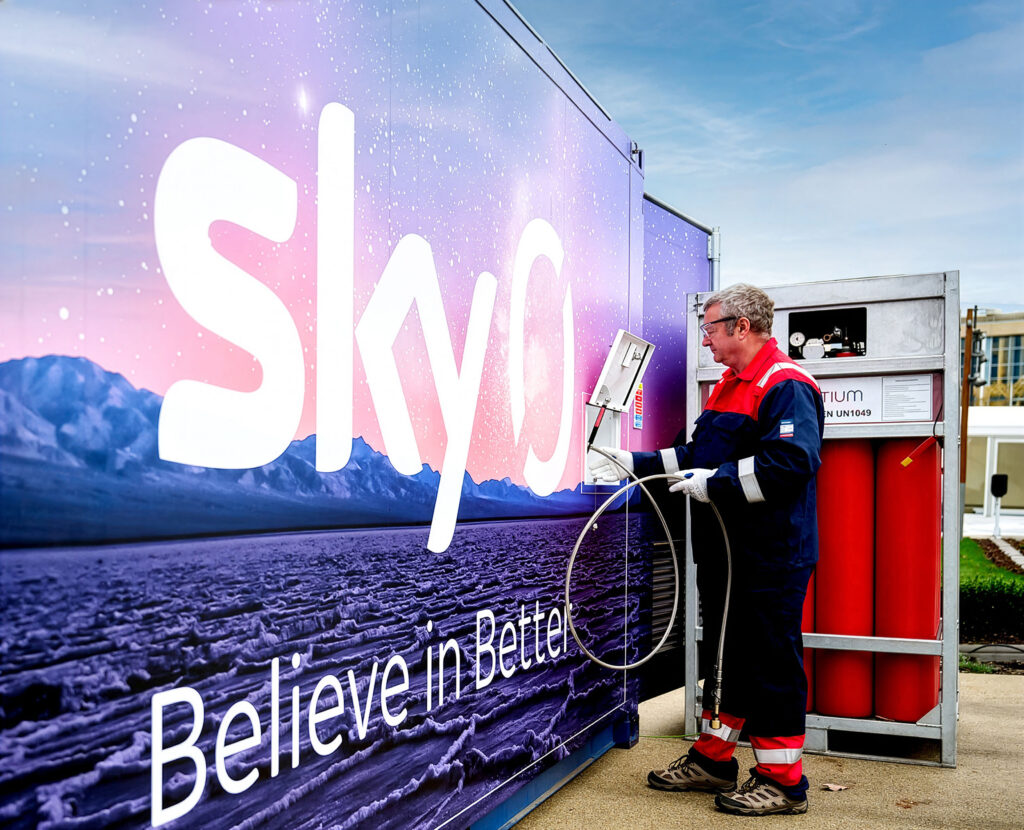
“We’ve seen first-hand the difference hydrogen power can make on film sets. At Neptune Sustainability, we’ve supported the deployment of hydrogen power units to supply various departmental needs, replacing the need for multiple diesel generators and achieving significant fuel and carbon savings. Beyond the environmental benefits, eliminating diesel exhaust fumes and significantly reducing noise pollution has created a noticeably quieter, cleaner and more comfortable working environment for cast and crew.” – Louise Smith, Neptune Sustainability.
That tension between good intentions and practical reality is exactly where productions get stuck. The good news is that there is no longer a single choice between “diesel” and “nothing”. There is a spectrum of options, and most productions will use more than one.
The set-friendly power options, explained
The right option depends on how much power you need, for how long, and where. Most productions will use a mix, which is the approach the industry’s SPARK roadmap sets out. (BAFTA albert, SPARK)
Grid connection.
Why it’s used: the simplest clean option where a supply exists.
The catch: many of the best locations have no connection at all.
Batteries.
Why they’re used: silent, with no emissions at the point of use.
The catch: limited runtime, and they need recharging, often from another power source.
HVO (hydrotreated vegetable oil).
Why it’s used: it runs in many existing diesel generators.
The catch: it is still burned in an engine, so noise and exhaust remain, and its green credentials depend on its feedstock. The Department for Transport has investigated claims of virgin palm oil being relabelled as waste (Fleet World), and Transport & Environment estimates that HVO at best halves CO2 against fossil diesel (T&E).
Hybrid generators.
Why they’re used: a battery lets the engine run less, cutting fuel use and noise.
The catch: they still depend on a combustion fuel.
Where Protium fits in
Protium’s hybrid green hydrogen generators are designed as a drop-in replacement for diesel gensets, so productions can change the fuel without changing how they work. Units range from 4 kW to 500 kW, covering everything from a single lighting setup to a full outside broadcast compound.
Quiet enough for sound. The fuel cell runs at around 65 dB, comparable to a conversation or a refrigerator’s hum (source: EODev). Sound departments get clean takes without fighting generator noise.
Stable power for sensitive kit. The hybrid system holds a steady voltage through load spikes and drops, protecting cameras, live feeds and uplink equipment.
Data that feeds your footprint. Point-of-use emissions data can go straight into a production’s albert carbon footprint and certification.
The whole production, not just the camera. The same units can run welfare cabins, catering, lighting, cast heating and off-grid EV charging at basecamp.
Green Hydrogen delivered to your schedule. Protium produces green hydrogen from renewable electricity and delivers it by road to the set, studio or OB compound. Mobile storage ranges from 16 kg to 720 kg, sized to the space available, and the power the production needs. Location, power demand, and operating hours shape the supply plan, which Protium agrees with the production in advance.
Safety built in. Hydrogen is stored in certified high-pressure cylinders with pressure relief, monitoring, ventilation and gas detection. Every deployment is planned around the site, including layout and separation distances, before the first delivery arrives.
In practice: a week of live TV with no diesel on site
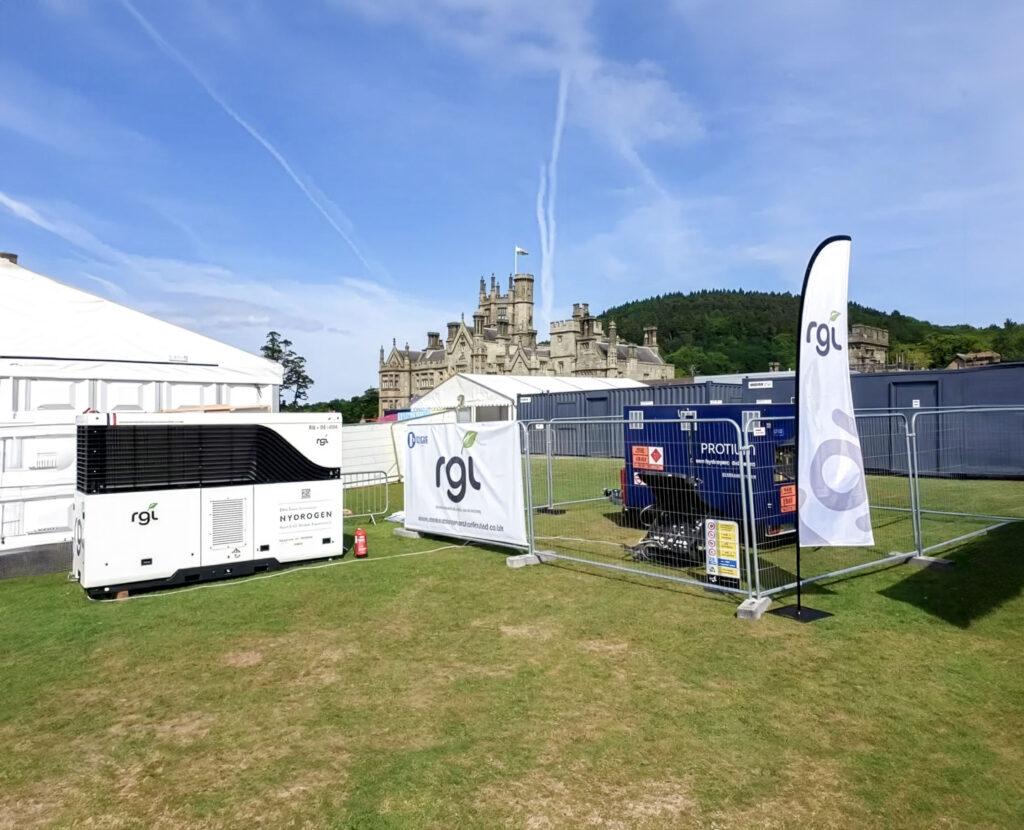
At the Eisteddfod Youth Festival in Wales, production company Afanti needed reliable off-grid power for a live TV studio broadcasting to S4C across the week-long event.
Protium supplied a hydrogen fuel-cell generator to run the studio and a second unit for off-grid EV charging. A battery charged by the generators kept hair, make-up and lighting running too, covering the wider production footprint, not just the camera package.
The set-up ran without fault for the full week, with no diesel on site.
Getting started
The easiest way to begin is with one part of the shoot, not the whole production. Pick the setup where diesel causes the most friction, such as a sound-sensitive location, a night shoot or a basecamp near homes, and plan cleaner power in from prep.
- Map your power needs early. Note locations, loads and operating hours during prep, when choices are cheapest to change.
- Match the option to the job. Grid where available, batteries for small and short loads, hydrogen hybrids where you need more power for longer.
- Talk to suppliers before the recce, not after. Delivery, storage and site layout all need planning time.
- Capture the data. Make sure your power supplier can provide the figures your albert footprint needs.
Planning your next location?
Talk to Joe Hartigan, our Hydrogen Business Development Lead, about quieter, cleaner off-grid power for your production joe_hartigan@protium.co.uk
and read more about Protium’s solutions for Film and TV here